
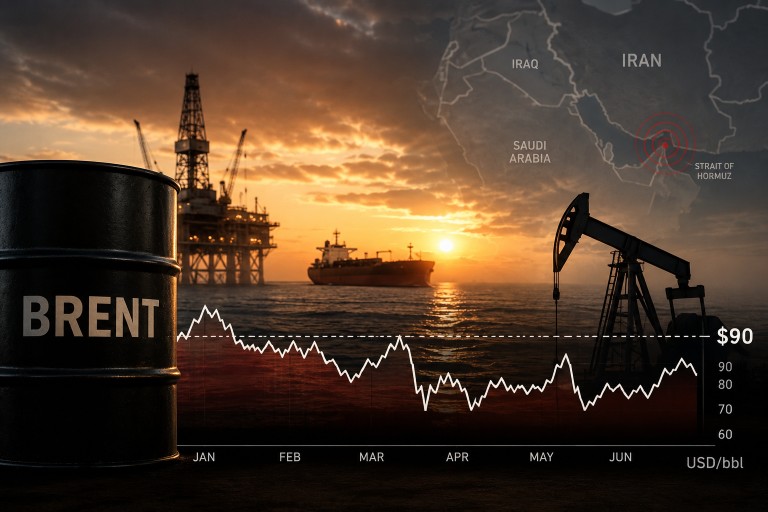
Brent crude oil prices are facing challenges in surpassing the $90 per barrel mark, despite experiencing their most significant weekly rise since April. On Friday, the global benchmark was trading close to $85, contributing to an 11% increase over the week. Meanwhile, West Texas Intermediate, the U.S. counterpart, was nearing $80. This uptick in prices has been driven by renewed military tensions between the United States and Iran, which have disrupted Middle Eastern supply routes and slowed down tanker traffic through the strategically crucial Strait of Hormuz, a passageway for about 20% of the world’s oil.
Although the conflict in the region has intensified, and tanker movements through Hormuz have considerably decreased, Brent crude has struggled to climb beyond $87.55 per barrel, a peak reached earlier in the week. Analysts suggest that the possibility of diplomatic resolutions still tempers further price increases, as the market remains hopeful that talks could prevent a prolonged disruption. Observers are keeping a close eye on whether global oil inventories begin to deplete significantly and if the disruption in Hormuz becomes an extended issue.
Despite the escalating military confrontations, the oil market has shown resilience, with Brent trading within a tight range recently. This stability indicates that investors currently expect the tensions to de-escalate rather than escalate further. The Strait of Hormuz remains a focal point for energy markets, as tanker traffic slows down and exporters increasingly seek alternative routes to lessen their reliance on this vital channel.
The ramifications of these developments extend beyond crude oil. In the United States, refining margins are on the rise due to tightening supplies of diesel and gasoline, while European fuel markets are also experiencing pressure. Additionally, reduced fuel exports from Russia have compounded the strain on global energy supplies. Market participants are closely monitoring two critical factors: a potential decline in oil inventories that could signal a supply shortage and the outcome of diplomatic efforts in the Gulf, which, if unsuccessful, might lead to a more extended disruption.
Until there is clear evidence of either a significant drop in inventories or failed diplomatic negotiations resulting in prolonged disruption, analysts predict that Brent crude is likely to remain below the $90-per-barrel threshold, despite heightened geopolitical risks in the region.